Flange Depths & Cine Adapters
The distance between the lens mechanical seating plane and the digital sensor plane (flange focal distance) governs optical performance. Short mirrorless flange distances offer unprecedented flexibility, but mounting heavy cine glass requires precision shimming to ensure focus barrel witness marks remain accurate.
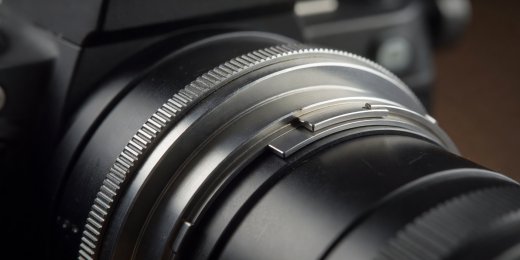 Mount Tolerances
The Importance of Precision Shimming
Standard PL lenses operate on a strict 52.00mm flange depth. When mounting a PL lens to a Sony E-mount (18.00mm flange depth) via a 34.00mm adapter, any manufacturing deviation of even 20 microns will throw off the witness mark alignments. A first camera assistant pulling focus by physical distance measurements on a tape measure will miss critical eye sharpness when adapter tolerances are sloppy.
Full-Frame vs Super 35 Vintage Anamorphic
Legendary anamorphic lenses, such as Lomo round-fronts, Cooke Anamorphic/i, and Atlas Orion, are primarily computed for Super 35 sensor heights (approx. 18mm vertical). Mounting them onto full-frame sensors without enabling an in-camera Super 35 crop produces aggressive mechanical vignetting. However, full-frame cameras with customizable aspect ratio modes allow operators to squeeze authentic anamorphic rendering without resolution loss.
Industry Lens Mount Flange Focal Distances
| Mount System | Flange Focal Distance | Throat Diameter | Adaptability Rating |
|---|---|---|---|
| Positive Lock (PL) | 52.00 mm | 54.0 mm | Universal Cinema Standard (Native or Adapted) |
| Sony E-Mount | 18.00 mm | 46.1 mm | Exceptional (Adapts PL, EF, Leica M, LPL) |
| Leica L-Mount | 20.00 mm | 51.6 mm | Exceptional (Wide throat for heavy PL lenses) |
| Canon RF-Mount | 20.00 mm | 54.0 mm | High (Accommodates drop-in rear ND filters) |
| ARRI LPL | 44.00 mm | 62.0 mm | Optimized for large-format VistaVision sensors |
| Canon EF-Mount | 44.00 mm | 54.0 mm | Legacy Standard (Easily adapted to mirrorless) |
Camera Rig Prep & Lens Collimation Checklist
Generate and verify your pre-shoot equipment manifest. Check off verified components, append production notes, and export a clean plain-text dispatch manifest.